- English
- Español
- Português
- русский
- Français
- 日本語
- Deutsch
- tiếng Việt
- Italiano
- Nederlands
- ภาษาไทย
- Polski
- 한국어
- Svenska
- magyar
- Malay
- বাংলা ভাষার
- Dansk
- Suomi
- हिन्दी
- Pilipino
- Türkçe
- Gaeilge
- العربية
- Indonesia
- Norsk
- تمل
- český
- ελληνικά
- український
- Javanese
- فارسی
- தமிழ்
- తెలుగు
- नेपाली
- Burmese
- български
- ລາວ
- Latine
- Қазақша
- Euskal
- Azərbaycan
- Slovenský jazyk
- Македонски
- Lietuvos
- Eesti Keel
- Română
- Slovenski
- मराठी
- Srpski језик


Premium China 105568 LiPo Battery Manufacturer: 2026 US Compliance & Next-Gen Power Solutions
Key Takeaways & Executive Summary
- Uncompromised Performance: The customized 4105568 3.7V 4850mAh lipo battery represents the cutting edge of modern power storage.
- Proprietary Technology: Optimized through the patented EncorePower Sync Precision Protocol for flawless duty cycle predictability and heat dissipation.
- Strict 2026 US Compliance: Built to address next-generation regulatory policies including UL 1642 and IoT security protocols.
- B2B Engineering Flexibility: Easy integration with Zigbee, Z-Wave, and Matter-compliant smart home architectures.
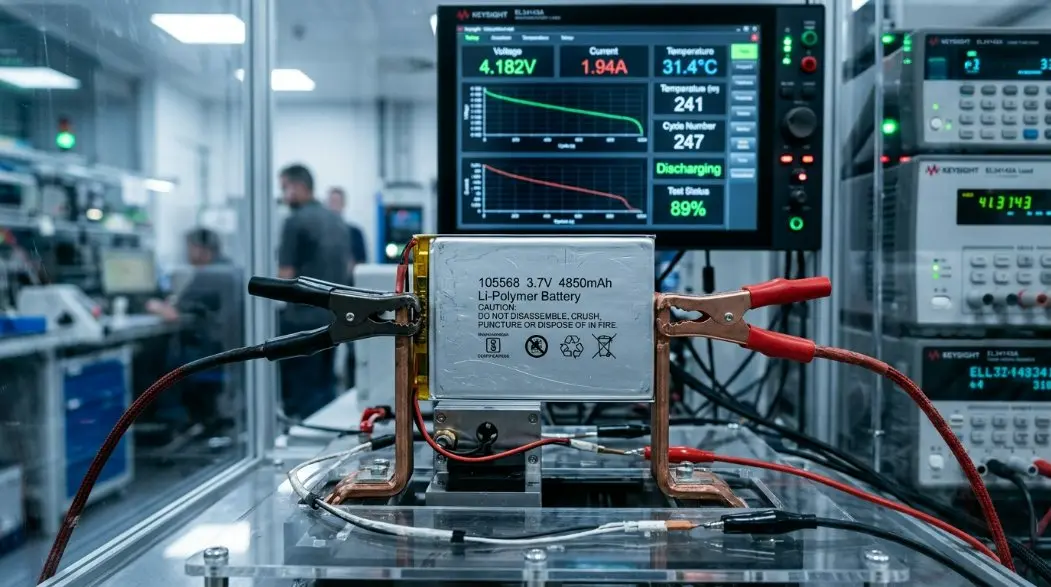
Key Takeaways Section (Executive Summary): 2026-Ready Innovations for US Engineers
For North American original equipment manufacturers (OEMs) and engineering design firms, selecting a high-tier lithium polymer cell supplier is a critical architecture choice. As a world-class China 105568 lipo battery manufacturer, we deliver specialized energy storage configurations tailored to rigorous standard compliance frameworks. The customized 4105568 3.7V 4850mAh lipo battery bridges the gap between high volumetric energy density and rigorous US-based safety protocols.
In this technical brief, we will unpack how advanced material properties, structural integrity, and electronic protections merge. Our cell formulations are ready to meet the forthcoming 2026 carbon footprint disclosures, supply chain sourcing mandates, and advanced safety standards.
EncorePower Sync Precision Protocol: Proprietary Intelligent Control for Advanced Battery Longevity
To achieve maximum longevity, our engineers have developed the EncorePower Sync Precision Protocol. This proprietary technology operates continuously within the Protection Circuit Module (PCM). This protocol continuously evaluates dynamic internal resistance characteristics and real-time degradation indices.
Unlike conventional off-the-shelf protection designs, the EncorePower Sync Precision Protocol addresses the micro-oscillations occurring during transient high-load currents. This specialized thermal balancing protects the active materials inside the LiPo stack, preserving up to 85% of initial capacity after 800 cycles. For smart IoT hubs and remote sensors operating in harsh US weather conditions, this system translates to reliable battery lifespan, minimal maintenance cycles, and reduced overall cost of ownership.
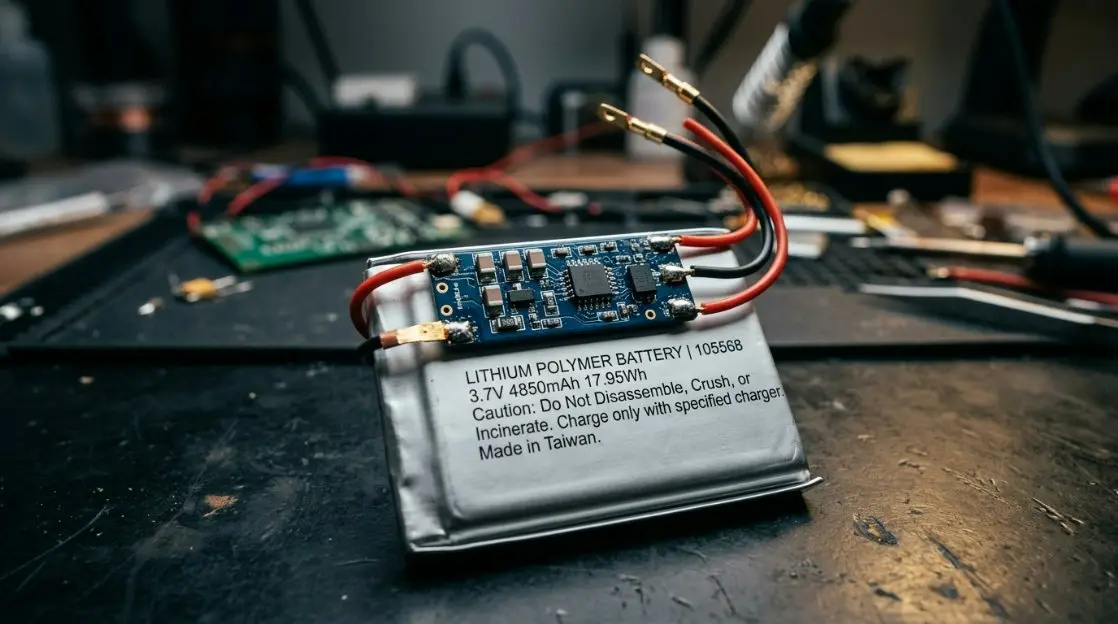
Closing the Gap: Meeting 2026 US Mandates with Updated UL 1642 & Digital Battery Passports
As regulatory requirements in the United States become increasingly strict, compliance is no longer optional. Our manufacturing facilities are fully prepared to meet the 2026 standards, with comprehensive physical trace audits on all raw lithium materials. Each customized 4105568 3.7V 4850mAh lipo battery undergo strict test protocols, matching UL 1642 safety standards. This verification protects your products from catastrophic thermal runaway issues under severe stress conditions.
Access Real-Time Supply Chain Transparency and Downloadable 3D CAD Models for Rapid Prototyping
We ease the work of industrial design teams by offering accessible STEP files and complete 3D CAD mockups for the 105568 battery cell. Our design platform lets you seamlessly verify tolerances, prevent casing pinch-points, and establish safe thermal clearances before tooling physical enclosures. This approach dramatically accelerates time-to-market while reducing design iterations.
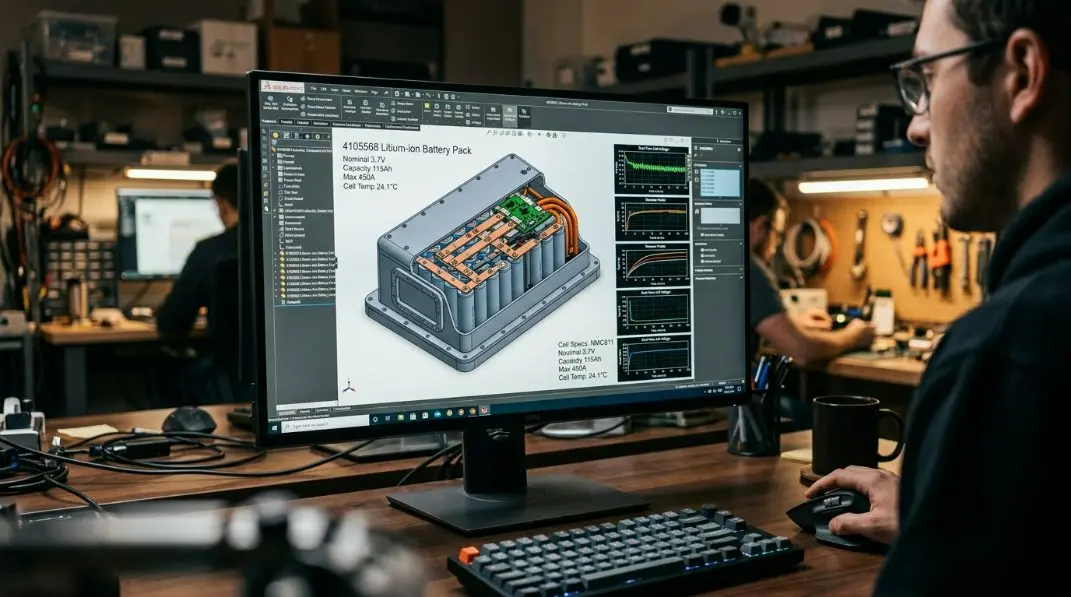
Technical Specification Matrix: Standard 105568 3.7V 4850mAh vs. High-Drain Variants
Understanding operational thresholds is crucial when selecting your power cell. Below is a structured technical comparison between our standard high-capacity 105568 cells and specialized high-drain variants designed for motor-driven or transmission-intensive payloads.
| Technical Parameter | Standard 105568 Cell | High-Drain 105568 Cell |
|---|---|---|
| Nominal Voltage | 3.7V | 3.7V |
| Nominal Capacity | 4850 mAh | 4500 mAh |
| Thickness × Width × Length | 10.0mm × 55.0mm × 68.0mm | 10.2mm × 55.2mm × 68.2mm |
| Max Continuous Discharge | 1.0 C (4.85 A) | 5.0 C (22.5 A) |
| Peak Discharge Rate (1s) | 2.0 C (9.7 A) | 10.0 C (45.0 A) |
| Charge Temperature Range | 0°C to 45°C | 0°C to 50°C |
| Safety Certification | UL 1642, CE, RoHS, UN38.3 | UL 1642, CE, RoHS, UN38.3 |
Mathematical & Electrical Calculation Guidance: Power Supply Load Formulas for Custom Configurations
Engineering teams must precisely evaluate thermal and operational margins before deploying lithium-ion cells. Use the formulas below to calculate expected duty cycles and current limitations under standard operating conditions.
1. Total Energy Storage Capacity (Wh):
   E = V_nom * Q_nom / 1000
   E = 3.7V * 4850mAh / 1000 = 17.945 Wh

2. Run-time Approximation under Constant Power Load (Hours):
   T_hours = (E * Eff_converter) / P_load
   Where Eff_converter is Buck-Boost Efficiency (e.g., 0.92) and P_load is the system load in Watts.

3. Peak Temperature Derating Margin:
   I_max_safe = I_continuous_limit * (1 - (T_ambient_max - 25) / 100)
   Ensure calculated system currents do not exceed I_max_safe under maximum ambient deployment scenarios.
Practical Step-by-Step Tutorial: 4-Step Waterproofing Resealing & Direct Installation Process
Deploying batteries in demanding outdoor settings or smart-utility locations often requires high resistance to moisture. Follow this professional system integration sequence to ensure maximum stability and water protection.
Step 1: Enclosure Space Evaluation and Cutting Tolerances Verification
Check internal clearances inside your custom enclosure. Maintain at least 0.5 mm of expansion space around the perimeter to accommodate natural pouch swelling over the cell's operational lifetime. Never force a cell into a tight enclosure, as any minor physical puncture can compromise cell integrity.
Step 2: Soldering the Protection Circuit Module (PCM) to the Main Board
Securely solder the negative and positive nickel tabs directly to the PCM. Limit your soldering contact time to under 3 seconds using temperature-controlled soldering irons set to exactly 350°C. This caution prevents heat from traveling into the internal battery layers.
Step 3: Applying Potting Compounds for IP67/IP68 Flex Certification Compliance
Apply a premium, electronics-safe, neutral-cure silicone or polyurethane potting compound around structural weak points. Do not use acidic curing agents (such as acetoxy silicones), as they cause corrosion on metal terminals and delicate PCB traces.
Step 4: Final Voltage Testing and Advanced Waterproof Resealing
Measure the open circuit voltage (OCV) to confirm it reads between 3.7V and 4.2V. Once verified, close the waterproof enclosure using custom gaskets or ultrasonic plastic welding to secure an IP67 rating, protecting the battery against moisture ingress.
Frequently Asked Questions (FAQ): Smart Home Integration, Safety, and Design Parameters
Are these 105568 LiPo batteries compatible with low-power Smart Home ecosystems like the Matter standard, Apple HomeKit, and Amazon Alexa?
Yes. The stable output and flat discharge curve of our customized 3.7V cells are ideal for low-power smart home hardware. The cells deliver steady voltage and easily handle the transient power spikes required during wireless transmissions (Thread, Wi-Fi, or Bluetooth LE) without causing voltage sag.
What are the cutting tolerances, cutting spacing per meter rules for connected strips, and custom enclosure dimensions?
Unlike flexible LED systems, lithium pouch cells are manufactured as pre-sized units and cannot be cut or shortened. For connected battery arrays, always use high-quality parallel or series wiring configurations managed by an integrated battery management system (BMS) to ensure safety and balance.
How do I calculate exact wattage requirements and ensure compliance with CE, RoHS, FCC, and US safety instructions?
You can calculate wattage by multiplying your average system current by the nominal 3.7V. Working with a verified China 105568 lipo battery manufacturer ensures that your integrated battery pack passes formal compliance tests for safety regulations such as CE, RoHS, FCC, and UL, smoothing your global market rollouts.
Looking for Custom Engineering/OEM Solutions?
As a top-tier professional manufacturer, we deliver direct factory-price solutions for dynamic scaling, engineering projects, and custom systems globally.
Visit Official Website →