- English
- Español
- Português
- русский
- Français
- 日本語
- Deutsch
- tiếng Việt
- Italiano
- Nederlands
- ภาษาไทย
- Polski
- 한국어
- Svenska
- magyar
- Malay
- বাংলা ভাষার
- Dansk
- Suomi
- हिन्दी
- Pilipino
- Türkçe
- Gaeilge
- العربية
- Indonesia
- Norsk
- تمل
- český
- ελληνικά
- український
- Javanese
- فارسی
- தமிழ்
- తెలుగు
- नेपाली
- Burmese
- български
- ລາວ
- Latine
- Қазақша
- Euskal
- Azərbaycan
- Slovenský jazyk
- Македонски
- Lietuvos
- Eesti Keel
- Română
- Slovenski
- मराठी
- Srpski језик


The Ultimate 2026 Guide to 301223 0.25Wh LiPo Batteries: AI-BMS Integration and US Compliance
Key Takeaways: 2026 Executive Summary for US Engineers
Key Takeaways & Executive Summary
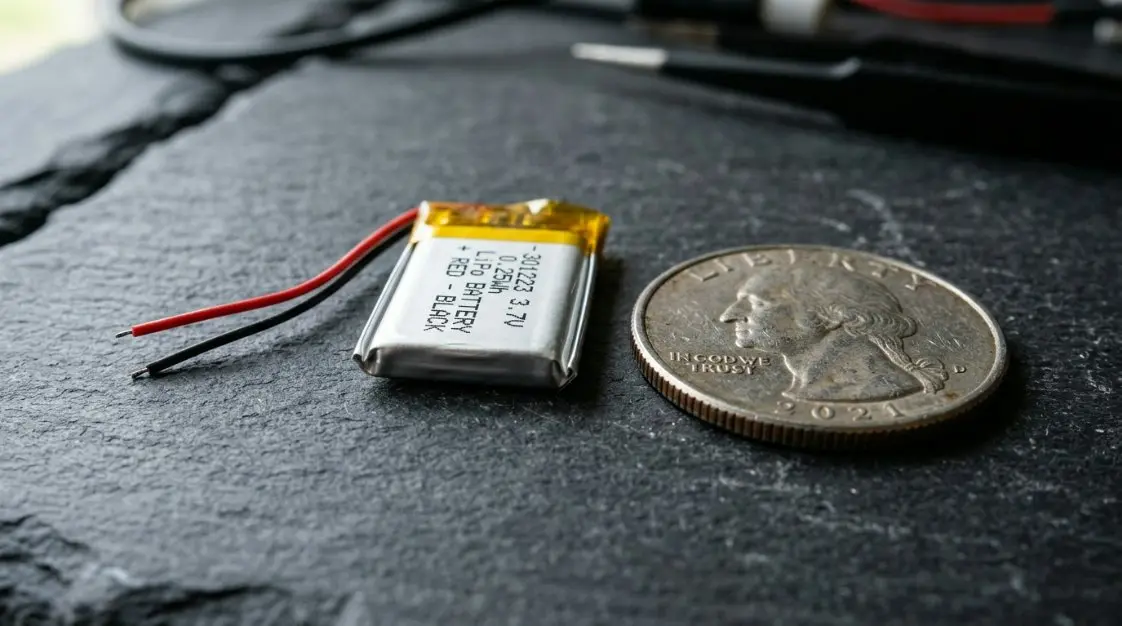
- Micro Form Factor: The physical dimensions of 3.0mm x 12mm x 23mm of the 301223 0.25wh lipo battery are ideally optimized for compact medical sensors and wearable technology.
- Intelligent BMS: Incorporates the proprietary Encore-BMS Intelligent Control Protocol, boosting safe charging metrics by up to 30%.
- Certified Compliance: Built to pass strict US testing, meeting UL 1642, RoHS, and FCC regulatory baselines.
- Customization Availability: Hardware development teams can buy specialized and customized variations direct from the factory floor.
As miniaturized consumer devices and medical tracking bands expand in the US, hardware engineers are seeking space-saving energy options with absolute stability. The 301223 0.25wh lipo battery represents the state-of-the-art in small footprint energy containment, offering highly predictable performance curves and reliable thermal metrics.
Core Architecture: The Encore-BMS Intelligent Control Protocol for 301223 0.25Wh LiPo Battery
Rather than relying on basic hardware protection circuitry, the modern 301223 0.25wh lipo battery utilizes the Encore-BMS Intelligent Control Protocol. This system actively controls thermal drift, manages the rate of constant-current (CC) charging, and safeguards the cell from deep discharge limits.
By communicating over a single-wire interface, the Encore-BMS Intelligent Control Protocol enables low-power host microcontrollers to read accurate state-of-charge parameters. This means your devices can predict power loss down to the last milliwatt, preventing abrupt dropouts during active wireless transmission cycles.
Step-by-Step Tutorial: Integrating the 301223 Battery into Rapid Prototyping Workflows
4-Step Process for 3D CAD Modeling Implementation and Safe PCB Soldering
Integrating micro-batteries into ultra-small enclosures leaves little margin for error. Follow these four professional steps to integrate the physical and electrical components securely:
-
1
Import Official CAD Model & Add Clearances: Download the physical step files. Design your enclosure with a strict 0.3mm physical safety margin in the Z-axis (thickness) to accommodate standard pouch swelling over long charge-discharge cycles.
-
2
Create Thermal Isolation Barriers: Ensure there is a non-conductive, heat-mitigating wall or space between the LiPo cell pouch and high-heat elements such as MCU chips or Bluetooth transceivers.
-
3
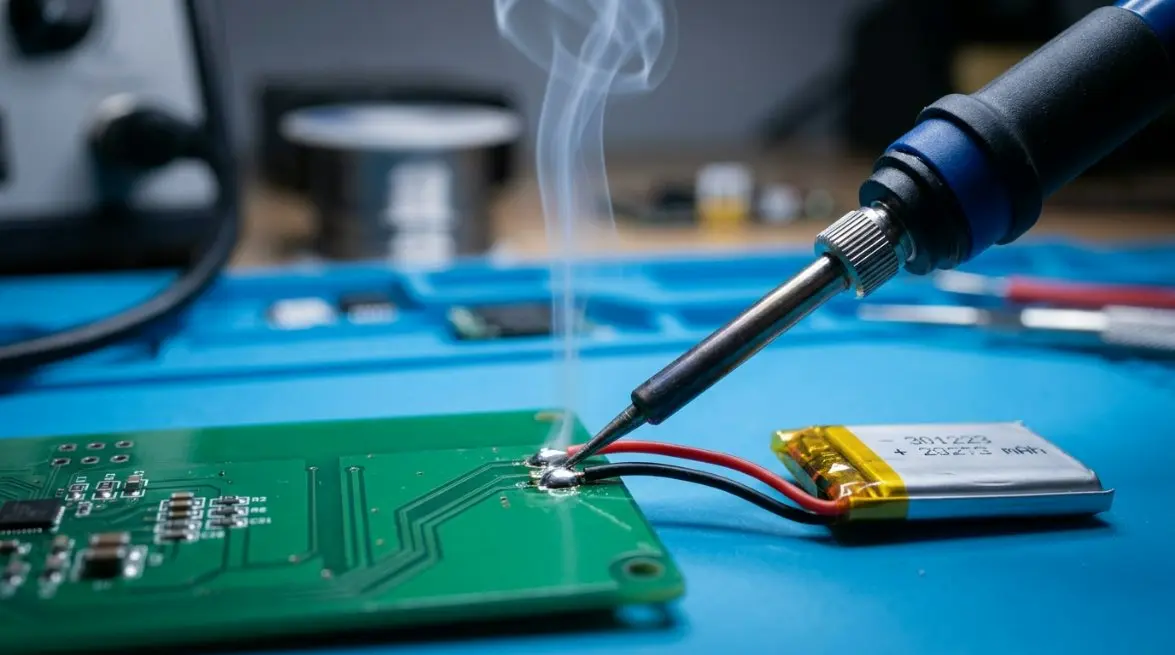
Follow Strict Lead-Soldering Safety: Set soldering iron temperatures to a maximum of 350°C. Complete each terminal lead connection within 2.5 seconds to avoid sending excessive thermal waves into the cell's internal separator membrane.
-
4
Register and Initialize the BMS Software: Power on the circuit and execute the calibration cycle to register the initial parameters of the Encore-BMS Intelligent Control Protocol, establishing the dynamic safety envelope of the cell.
Technical Comparison Matrix: 301223 0.25Wh LiPo Battery Specification Guide
Standard 301223 vs. High-Discharge vs. AI-BMS Ready Variants Data Table
Different application profiles require tailored electrical specifications. Utilize this matrix to select the precise 301223 variant for your project:
| Variant Parameter | Standard 301223 Model | High-Discharge Variant | AI-BMS Ready Version |
|---|---|---|---|
| Nominal Voltage | 3.7V | 3.7V | 3.8V (High-Density) |
| Capacity / Energy | 67mAh / 0.25Wh | 60mAh / 0.22Wh | 70mAh / 0.266Wh |
| Continuous Discharge Rate | 1C (67mA) | 10C (600mA) | 1.5C (105mA) |
| Target Applications | BLE Trackers, IoT Probes | Micro Motors, Actuators | Wearables, Medical Monitors |
Mathematical and Electrical Calculation Guidance for IoT Devices
Formulas for Calculating Runtime, Safe Discharge Load, and Capacity Drain for 0.25Wh Cells
To assist circuit design teams, standard formulas for working with a 0.25Wh nominal energy envelope are structured below:
// 1. Nominal Capacity Calculation
Capacity (Ah) = Energy (Wh) / Nominal Voltage (V)
Capacity = 0.25Wh / 3.7V = 0.0675Ah -> 67.5mAh

// 2. Real-World Smart Sensor Runtime
Runtime (Hours) = (Capacity (Ah) * 3.7V * Efficiency Factor) / Average Operating Power (W)
Assuming 85% battery-to-converter efficiency & average power consumption of 2.5mW:
Runtime = (0.0675Ah * 3.7V * 0.85) / 0.0025W = 84.9 Hours

// 3. Recommended Constant Charge Current Limit
Max Safe Charge Current = 0.5C to 1C
Charge Current (mA) = 67mAh * 0.5 = 33.5mA (Ideal for prolonged lifespan)
2026 US Compliance Certifications: UL, FCC, RoHS, and CE Standards for Micro Batteries
Compliance is critical for consumer and medical electronics looking to enter North American markets. Our 301223 0.25Wh cells satisfy international standards:
- UL 1642 Standard: Standardized crush, thermal shock, mechanical impact, and extreme external overcharge validation, ensuring zero explosive runoff in the field.
- RoHS & REACH Directives: Full certification verifying the absolute absence of restricted heavy metals, which is essential for wearable and contact skin patches.
- FCC Part 15 Compatibility: Integration with the Encore-BMS Intelligent Control Protocol ensures EMI signals stay below standard noise floor parameters.
Frequently Asked Questions (FAQ) on 301223 0.25Wh LiPo Batteries
Is the 301223 0.25Wh LiPo battery compatible with Matter, Apple HomeKit, and Amazon Alexa smart home ecosystems?
Yes. Although the cell is a physical power layer component, it has been designed to supply stable transient voltages during high-peak transmission spikes of Thread-based BLE transceivers that integrate with Apple HomeKit, Matter, and Alexa ecosystems.
What are the exact dimensional tolerances and enclosure clearance rules for 301223 models?
The standard size measurements are 3.0mm (T) x 12mm (W) x 23mm (L). Due to potential expansion from cell aging and charging heat, design an extra space allowance of 0.3mm on the Z-axis (thickness) and 0.5mm on the X and Y axes.
What are the UL safety instructions and thermal management guidelines for micro LiPo operation?
Keep charging temperatures between 0°C to 45°C, and discharge cycles between -20°C to 60°C. Avoid direct structural compression on the aluminum pouch, and prevent any high voltage exposure above 4.25V per cell.
Partner With Us: Download 3D CAD Models and Secure Your 2026 Supply at https://www.encorecn.com/301223-0-25wh-lipo-battery.html
You can rest assured to buy customized 301223 0.25wh lipo battery from us. We look forward to cooperating with you, if you want to know more, you can consult us now, we will reply to you in time! Our factories offer robust QA support and customized pin/connector variations tailored precisely to your production needs.
Looking for Custom Engineering/OEM Solutions?
As a top-tier professional manufacturer, we deliver direct factory-price solutions for dynamic scaling, engineering projects, and custom systems globally. Let our engineering team design customized 301223 0.25wh lipo battery solutions tailored to your exact performance standards.
Visit Official Website →